Jump to content
Jump to footer
Long concrete bridge spanning the Loire River with numerous small boats anchored in shallow water at low tide. Sandy beach in foreground.

Travel report Loire: from Tours to the Atlantic ocean

What comes to mind when you hear Loire?  Perhaps a wide, sedate river flowing lazily in gentle loops,  its banks dotted with vineyards, castles and stately homes with magnificent gardens?

You can start anywhere along the 1,012 km long river. Why not in beautiful Tours, the former capital of France?

Travel report **Loire: from Tours to the Atlantic ocean**

Perfect weather in the Valley of the Kings a bike ride along the Loire

And where, pray tell, is the Loire? Well, a little à gauche (left) and then à droite (right) up ahead, and then you'll see it. The old man shakes his head in incomprehension; anyone here could find it in their sleep, he says, waving his baguette wrapped in white paper around the middle. But don't worry, the signage is perfect!

Heading south in bright sunshine, I set off along France's longest river and continue along the south bank of the Cher, which flows into the Loire just beyond Villandry, on well-maintained cycle paths and former towpaths, sometimes also on small, quiet side roads between castles, forests and vineyards. I am the only cyclist far and wide. There is no sign of the proverbial French enthusiasm for cycling, and even tourists seem to only appear here in busloads, armed with camcorders.

Wetland area along the Loire River with shallow water pools, white birds, and lush green vegetation under a cloudy sky.

Being able to choose is probably the most difficult challenge on the Loire Valley Cycle Route, so I head for the next little castle. At the Château de Villandry with its terraced gardens, there is a car park specially designed for cyclists with a sign, surrounded by a hedge. A royal setting! The narrow streets of this village offer trinkets and knick-knacks and a bar-café, where a group of French racing cyclists also stop for a quick beer on tap, or “pressions” as they are called.

Hungry? Thirsty? No problem for cyclists in France. Every bistro, café and restaurant offers baguettes with fillings, and on the Loire these include the local speciality rillettes (sausage pâté). To drink, there's café au lait, eau minéral and much more. You're usually best off with the ‘plat du jour’, an inexpensive dish of the day. Or you can get lost, like I did, in a PMU café, where men who are slightly or heavily intoxicated bet on horses or who knows what else. In any case, not on cyclists, that much is certain. No one even glances at me; all eyes are fixed on the screen, where a few horses are racing around the track again. One more sip, and the cider is gone.
 

A French baguette wrapped in white paper with text is strapped to red bicycle panniers using black straps.

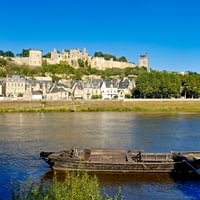
Anglers line the banks of the Loire itself, sitting in the tall grass and waiting patiently for a bite. The river glistens in the sun. And Langeais follows hot on its heels: the local fortress towers over the town and river valley on a rocky outcrop and is furnished in the so-called Flamboyant Gothic style. Even from the outside, the three round towers and the mighty drawbridge are impressive. Curiously, from the outside it looks like a medieval defensive castle, but from the garden side it looks like a royal Renaissance building. Inside, 16 rooms are open to visitors, some of which are decorated with magnificent medieval tapestries. Also worth seeing are the Renaissance gardens with their neatly trimmed bushes and the sequoia trees in the park.

There is a designated bicycle parking area at the moated castle of Azay le Rideau, which looks like a white jewellery box and is located slightly south of the Loire on the Indre river.

Ussé Castle, also located on the Indre, is on the edge of the Chinon forest. It is considered the fairytale castle par excellence, as it inspired Charles Perrault in the 17th century to write his fairytale ‘La Belle au Bois Dormant’ (Sleeping Beauty). It is built of white tufa with grey slate roofs and, of course, there are also enchanting gardens and parks here.

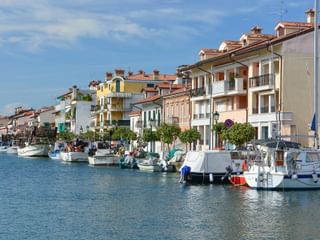
Small boats resting on muddy ground at low tide in a Loire harbor, with white houses and green vegetation visible in the background.

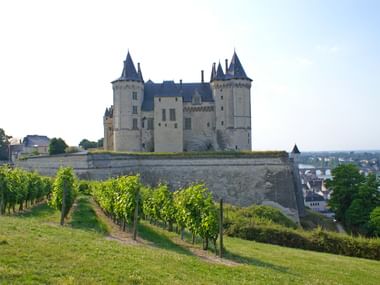
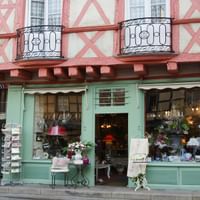
And so it goes on, to medieval Saumur with its grandiose château towering above the pretty old town with its quaint half-timbered houses, to Angers, which also has its own château, one with no fewer than seventeen slate-covered turrets. Down at Le Quai des Arts Vivants, there are almost always events of all kinds taking place. I just go with the flow and end up at Carée Cointreau, where you can learn all about the production and history of the famous liqueur. 

Medieval Château de Saumur with conical towers on hilltop overlooking vineyards and Loire River town below under blue sky.

The next highlight is Nantes: here, the Castle of the Dukes of Brittany stands right in the centre, but this time I am more interested in the city and its unusual squares. I am captivated by the Machine de l'île in the Parc des Chantiers: giant mechanical figures representing, for example, an elephant (my favourite) or a giant ant, a spider, a heron. It has a real wow effect. You can even ride on the elephant's back. That was a must, but now it's time to get back on the bike!

And so you can continue rolling along without any hassle to Saint Nazaire, past sandbanks, flat islands, wooden barges, grey herons, beaver lodges, magnificent monuments and ferries, and you are neither in the south nor in the north, because the Loire cuts France almost exactly in half.

Ornate vintage bicycle with curved frame and leather saddle displayed among lush tropical plants including ferns and monstera leaves in greenhouse.

Little Havana is full of pretty villas in different colours, one of which is even decorated with mosaics depicting daisies. Roses and hydrangeas bloom in the front gardens, thanks to the mild climate. So I'm not in the Caribbean after all. I am at the mouth of the Loire River where it flows into the Atlantic Ocean in St-Nazaire, France, and the district is so named because ocean liners used to depart from here for Cuba, among other destinations.

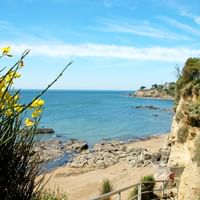
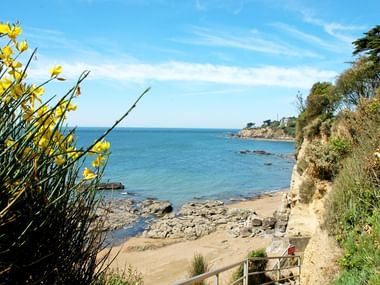
Coastal view along Loire cycle path to Atlantic with yellow flowers, sandy beach, rocky cliffs and blue ocean under cloudy sky.

I continue strolling along the promenade behind the sandy beach and head towards the harbour and the former submarine bunker, which was built by the Nazis during the Second World War. ‘The last commander refused to give up until three days after the end of the war, waiting for the order from Admiral Dönitz, Commander-in-Chief of the Kriegsmarine, to surrender,’ says Günter, shaking his head. And how does it feel to be a German living here, in a city with such a past? ‘No problem!’ he says, which is remarkable considering that because of the bunker, the entire city was bombed by the Allies and 85% of it was destroyed. ‘But the inhabitants were warned by the Allies beforehand and moved to the surrounding area,’ says Günter. The reinforced concrete of the bunker, however, held up. Today, people are quite relaxed about this indestructible legacy: it now houses various museums and an event hall. A Tintin poster hangs in front of it, because the two were here together with Captain Haddock. Fans can hunt down the posters scattered throughout the city and enjoy them, because St-Nazaire is one of the few cities that appear in a Tintin comic. Understandably, they are proud of this.

I walk to the sea, where the waves crash onto the beach, more powerful than the lapping of the Loire that accompanied me, and think: Adieu, Loire! Bienvenue, Atlantique!

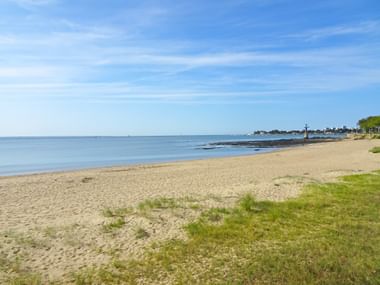
Wide sandy beach at St-Nazaire with calm blue ocean, green grass in foreground, and coastal buildings visible in the distance under a blue sky.

Our conclusion

Straight ahead, downstream, no significant inclines? That's right! It's straight ahead towards the Atlantic. You can really clear your head on this route. At first, I stopped at every little castle to admire it, but kilometre after kilometre, the journey itself became the destination. La Loire à Vélo is the name of the cycle path in French. The Loire Valley is incredibly beautiful, and it's no coincidence that France's kings chose to build their summer residences here.

Close-up portrait of Judith Weibrecht with reddish-brown hair, blue eyes, and turquoise earrings, smiling warmly at the camera.

Judith Weibrecht

Discover our other tours in Europe

Read more about our trips in the travel reports

You now receive special conditions when you book a trip.