1
Jump to content
(Link opens in a new tab)
Jump to footer
(Link opens in a new tab)
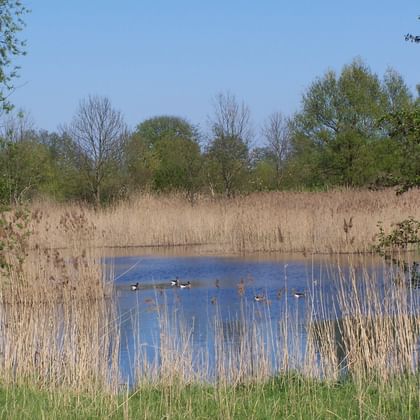
Tranquil pond in Havel wetlands with ducks swimming among dried reeds. Green grass in foreground, trees and blue sky in background.

Travel report: Havel-cycle-route

Can this river even be described as flowing? It only covers a drop of around 40 meters along its approximately 300-kilometer course. It describes a wide arc through the country, curving far to the east: the source and mouth are therefore close together, and the river makes a bend.
 

Travel report: Havel-cycle-route

A river bends

Flat country

We start in Waren, where the atmosphere is quite maritime: sails clack against masts in the marina. A light breeze blows and seagulls cry out their song. There is no sign of the Havel yet, because it does not have a single source. Instead, it is fed by many source lakes in and around the impressive Müritz National Park, home to beech, pine, and oak forests, heathland, lakes, and moors. Red deer, cranes, sea eagles, and ospreys live here. And the owl, symbol of the national park and nature conservation. Covering 32,000 hectares, it is the largest in Germany and also forms the watershed. We follow the course of the Havel to Ankershagen. It flows leisurely along. And just as leisurely, we roll along its banks on the fully signposted cycle path. There are no hills far and wide. Slopes are truly unheard of on this route. The next surprise awaits us in Ankershagen: a wooden Trojan horse stands in a meadow next to the Heinrich Schliemann Museum. The discoverer of Mycenae and Troy grew up here, where his father had taken up a position as a pastor.
Blue rectangular sign with orange bicycle icon and white text reading 'Havel RADWEG', marking the Havel cycling route.

The area is rich in water, and many lakes in the Ruppiner Land invite you to take a dip from the saddle. There are said to be a total of 55 lakes along just 8 kilometers of the river. Many of them are natural, but some circular ones were created because clay was once mined here. You can find out more about this at Mildenberg in the former VEB Ziegeleien Zehdenick, now Europe's largest brickworks park covering 42 hectares. "People used to live off clay here. The fired bricks were then mainly shipped to Berlin, where they were used to build houses,“ tells us one of the employees, who learned the profession of ceramic worker here and worked in a ring kiln at 65 degrees Celsius. Thirst guaranteed. Today, you can quench your thirst and satisfy your hunger at the ”Alter Hafen" inn, which serves goat cheese from the region and zander from the Havel River.

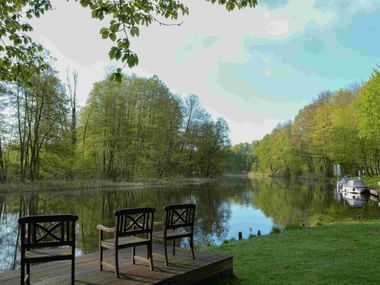
Three wooden chairs on a dock overlooking a calm lake surrounded by green trees. A sailboat is moored on the right shore under a blue sky.

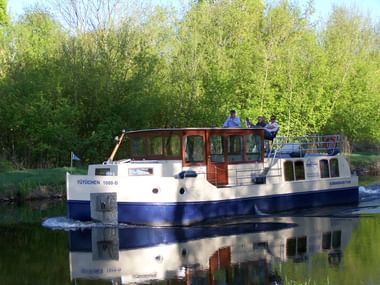
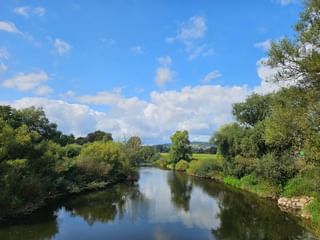
The grass glistens in the sunlight. A fisherman waits patiently for a bite, staring into the dark water. Storks chatter as they fly overhead, their nests visible all around on the chimneys and towers of the villages. Swans dip their necks into the water. Mighty deciduous trees line the path on both sides. Tall grasses shimmer in the evening light. A ship called “Tütüchen” chugs past. It is quiet here. The Havel Cycle Route can still rightly be considered an insider tip.
The river cycle route was opened in May 2009 and winds its way from the source in the Mecklenburg Lake District to the mouth of the Elbe, covering 350 kilometers along the Havel. It passes through four federal states: Mecklenburg-Western Pomerania, Berlin, Brandenburg, and Saxony-Anhalt. Most of the cycle path is paved or runs along quiet side roads.

White and blue houseboat named Tütüchen cruising on calm water with passengers on deck, surrounded by lush green trees along the Havel River.

Castles galore

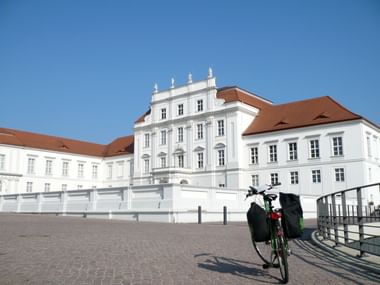
Prussian kings built an impressive number of imposing castles and parks on the banks of the Havel River. The baroque Oranienburg Palace, for example, is located directly on the bike path, and you should definitely pull over and visit it. It was once built as a country residence for the first wife of the Great Elector, Louise Henriette, Princess of Orange. Oranienburg Palace will not be the only one on this trip. They are strung like pearls along the cycle path. Illustrious names such as Sanssouci Palace in Potsdam, Cecilienhof Palace and Paretz Palace in Potsdam will follow. Prussia's history stretches along the Havel and the cycle path.

White baroque Oranienburg Castle with red tile roofs under blue sky. A touring bicycle with panniers stands on cobblestone courtyard.

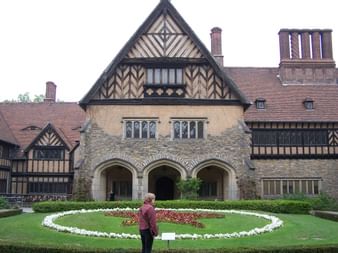
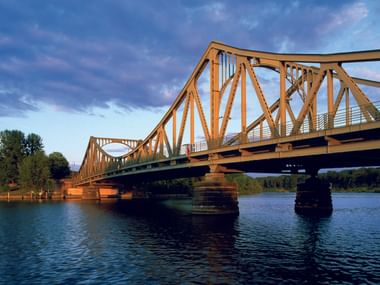
Now we cycle towards the waterfront town of Spandau, which was only incorporated into Greater Berlin in 1920. The people of Spandau are rightly proud of their natural location on the Havel, Spree, canals, and several swimming lakes. From the Sacrower Heilandskirche, inaugurated in 1844, whose tower was once integrated into the border wall, you can take a water taxi and admire the steel Glienicker Bridge, where spies and agents were exchanged between East and West during the Cold War, and observe peacocks, cormorants, and herons without having to pedal. You can disembark at the Cecilienhof/Meierei stop. In Cecilienhof Palace, now a hotel and museum, the room where the Potsdam Conference took place in 1945 has been preserved with its original tables and chairs.

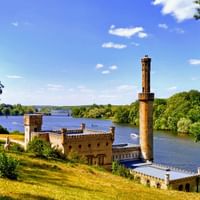
Glienicke Bridge, a steel truss bridge with yellow-orange framework spanning across blue water under a cloudy sky at golden hour.

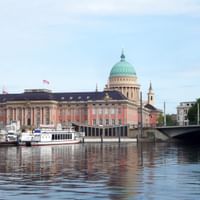
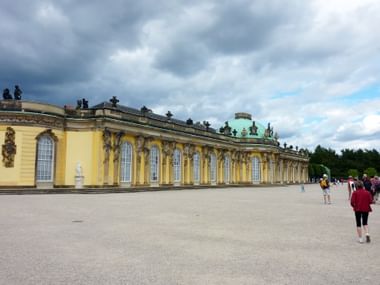
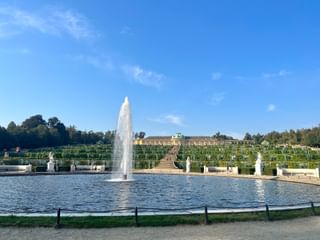
At the end of our trip, we arrive at Sanssouci Palace in Potsdam. It is also known as the Prussian Versailles and was built in the Rococo style. Incidentally, “Sans souci” (French) means “without worry” in English, because Frederick II simply wanted to enjoy himself here and forget the harsh realities of life. The palace is the former summer residence of Frederick the Great and houses, among other things, a concert hall, a palace library, and the impressive Marble Hall with an oval floor plan inspired by the Pantheon in Rome. Its extensive parks are famous. And now it's time to say goodbye to the Havel. What a royal, crowning finale!

Yellow baroque facade of Sanssouci Palace in Potsdam with ornate windows and green copper dome, visitors walking on courtyard.

Our conclusion

A dark river in green countryside steeped in Prussian culture: the Havel offers nature and culture galore on its banks in a region rich in castles. And then there is the beautiful Havel Cycle Route, where you can experience it all.

Close-up portrait of Judith Weibrecht with reddish-brown hair, blue eyes, and turquoise earrings, smiling warmly at the camera.

Judith Weibrecht

Our tours along the most beautiful rivers

Read our travel reports

Velociped newsletter
Subscribe now!
/en/newsletter-en

Sign up now for our newsletter and receive offers, tips and unique benefits directly in your inbox!

Subscribe now!
Large white envelope icon overlaid on scenic countryside with cyclists on gravel path through green fields under blue sky with trees.
You now receive special conditions when you book a trip.